Devin (Cognition): post-hoc evidence + a boundary gate
Devin proposes, Reeflex holds the irreversible step. This page covers two separate pieces, and neither of them is inline control over Devin:
| Post-hoc evidence | Boundary gate | |
|---|---|---|
| what it does | copies Devin's audit log and guardrail violations into your Reeflex organisation | asks reeflex-core before a CI job merges a Devin pull request or deploys |
| when | after the fact, on a schedule | before the merge or deploy step runs |
| where it runs | the Reeflex app (reeflex-app ingest devin) |
your GitHub Actions workflow |
| what Reeflex decides | nothing: the rows are labelled observed | allow, deny, or hold for a human |
| in Attest | its own section, counted in no control | the ordinary decision chain and the Art.14 hold trail |
What this covers and what it does not
Devin's API offers sessions, messages, secrets, knowledge, playbooks, enterprise audit logs and guardrail-violation records. It has no webhook, approval or policy endpoint, and its AI Guardrails screen the messages sent to Devin, not the actions Devin takes. So Reeflex does not see, hold or refuse anything Devin does inside its sandbox: shell commands, file edits, browsing, calls to services Devin holds credentials for. What Reeflex sees is (a) what Devin's own audit log records, after the fact, without a signature (its integrity rests on Devin and on the TLS connection it was pulled over), and (b) the steps that run in your CI, where this gate sits. A change that reaches production without passing through a gated CI step, or a merge on a branch where the gate is not a required check, is not seen by the gate. The gate decides on what the workflow declares about the change (the paths it touches, the axes in the envelope below). It does not read the diff, so whether a change is risky is up to the path list you configure.
Part 1 — Devin's audit log as observed rows in Attest
Status
Shipped in reeflex-app PR #196 (RFX-450), in review and not yet on app.reeflex.io as of 2026-10-22. Everything below was measured on that PR's image against a scratch database.
- In Devin, create a service user that may read audit logs, and copy its
token (
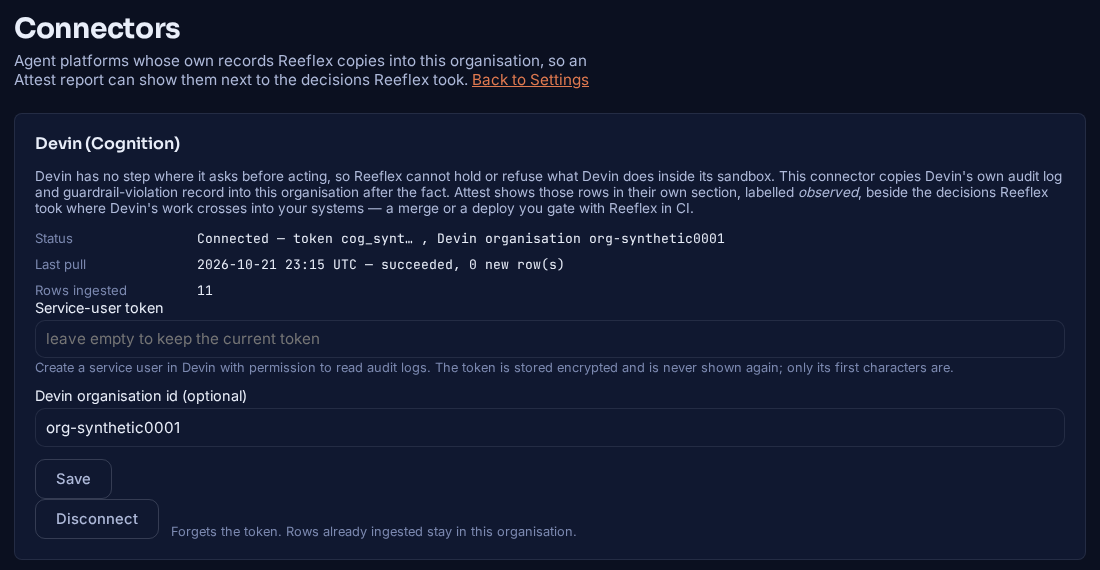
cog_…). - In Reeflex, open Settings → Connectors → Devin (Cognition). Paste the token and, if your enterprise has more than one Devin organisation, the organisation id. Saving the token and disconnecting are owner-only actions, and both are written to the tenant audit log, which records the token's first characters and not the token.
- The pull runs as
reeflex-app ingest devin, which an operator schedules (cron or a systemd timer). The first pull reads back 30 days. Each later pull stops at the newest row it already holds, and a row already held is counted as a duplicate rather than stored again (it is keyed on Devin's own id).
What is read: Devin's v3 enterprise API,
/v3/enterprise[/organizations/{org_id}]/audit-logs and
/v3beta1/enterprise[/organizations/{org_id}]/guardrail-violations.
What is stored: Devin's id, the action, the actor type and id, the Devin
session id, and the guardrail name and its action. Devin's free-form data,
the user's email, and a violation's flagged message text and reasoning are
not stored.
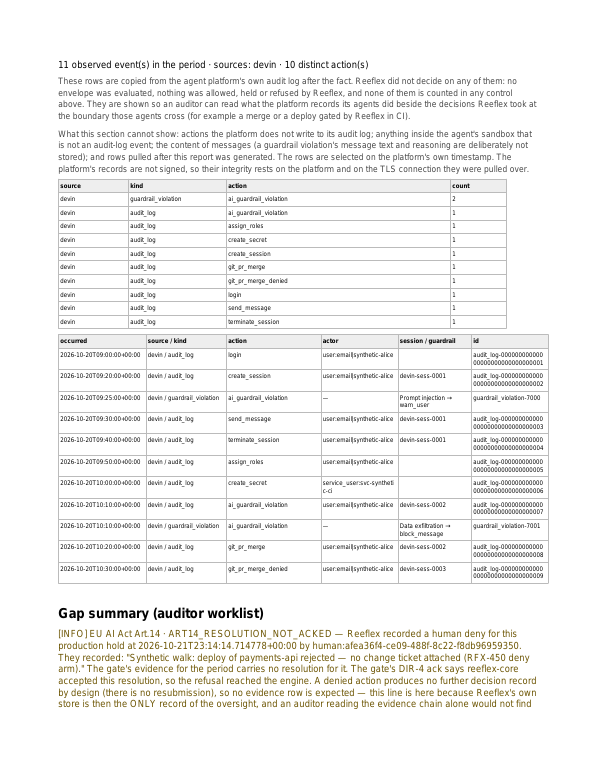
What Attest prints: a section headed Observed agent activity (no Reeflex
decision). It counts the rows by source, kind and action and lists them,
under a paragraph that says Reeflex did not decide on any of them. They are
not counted in any control, metric or gap. An organisation with no Devin
connector gets the same report it got before, with the same report_hash.
Part 2 — the boundary gate in GitHub Actions
The gate is one stdlib-only Python file plus a workflow. Both are in the repository:
integrations/devin/reeflex_boundary_gate.py
and
integrations/devin/reeflex-boundary-gate.yml.
What it gates
- Merge: a pull request whose author is in
REEFLEX_GATE_AUTHORS(defaultdevin-ai-integration[bot]) and whose changed files matchREEFLEX_GATE_PATHS. The default list ismigrations/,infra/,*.tf,*.tfvars,Dockerfile, and CI configuration (.github/workflows/,.gitlab-ci.yml,Jenkinsfile,.circleci/,azure-pipelines.yml). Any other pull request exits 0 without asking core, and the job summary says why. - Deploy:
reeflex_boundary_gate.py deploy --target <service>, as the step before your deploy step. It asks every time it runs.
What core is asked
A merge is sent as an update in the github namespace on
target.kind=branch, with target.ref=<repo>:<base branch>, the PR number,
head SHA and matching paths in params. It declares itself
reversibility=irreversible, blast_radius=broad, because a revert commit
does not un-run a migration. A deploy is an execute in the deploy
namespace. With environment=production, core's default pack answers both
with require_approval under reeflex.policy/irreversible_broad_prod (measured below).
| core answers | the step |
|---|---|
allow |
exits 0 |
deny |
exits 1 |
require_approval |
prints the hold id, polls GET /v1/holds/{id}; on approval resubmits the same envelope with the approval attached and exits by that answer; rejected, expired, or past REEFLEX_WAIT_SECONDS (default 1800) exits 1 |
| no answer (unreachable, 401, 5xx, unparseable) | exits 1 |
Install
- Copy
reeflex_boundary_gate.pyto.github/reeflex/andreeflex-boundary-gate.ymlto.github/workflows/in the repository Devin works on. - Set the repository variable
REEFLEX_CORE_URLand the secretREEFLEX_CORE_TOKEN. - Make the job
reeflex-merge-gatea required status check on the protected branch (branch protection or a ruleset). Without that, GitHub merges whatever the job says, including a merge Devin performs itself. - For deploys, add the step shown at the bottom of the workflow file to your deploy job, before the step that deploys.
The workflow runs on pull_request_target, so the workflow file and the
script come from the base branch. A pull request cannot edit the gate into
exit 0 and pass its own check. Nothing from the pull request is checked out:
the changed paths are read through the GitHub API. Keep it that way, because
this job holds the core token.
What the gate needs from your core
- A core your runners can reach, with an operator token. Core reads holds
with its operator token (
REEFLEX_AUTH_TOKEN) and nothing else. A portal-issued gate credential (rfx_ac_…) is accepted on/v1/decideand refused on the holds routes (reeflex-core/app/server.py, read, not measured here), so with one the gate can raise a hold but cannot see it resolved. It then fails closed and says so. - An approver core will accept. Since core 0.2.0 a hold is resolved by
a verified approver. In practice that means
REEFLEX_RESOLVER_TOKENSbound on the core, and the Reeflex connector carrying the matchingresolver_credentials, so an approval clicked in the portal reaches core. The hosted core behind app.reeflex.io reported"holds": {"resolvable": false, "reason": "verification_not_configured"}on its/healthzat 2026-10-21T23:08Z. A hold raised there cannot be approved today, and expires after its TTL (4 hours), which this gate reads as "do not merge".
What the approver sees
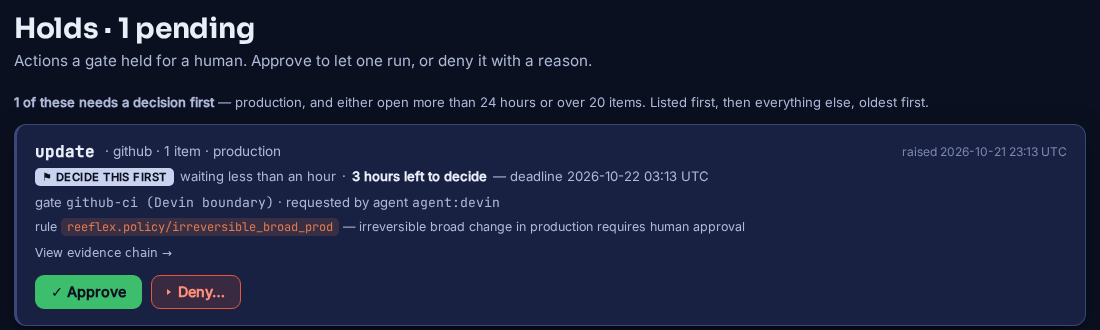
The portal's hold card shows the verb, namespace, environment, gate, agent and
rule: update · github · production, agent:devin. It does not show the
repository, PR number or file list, because core's audit line does not carry
params. Match the hold to the CI run by the hold id: the CI step prints
it, and the hold's View evidence chain drawer shows it.
Worked example — measured 2026-10-21
Measured on a scratch stack: reeflex-core from the image the hosted core runs
(ghcr.io/reeflex-io/reeflex-core:v0.2.3, same image id), with one verified
approver bound; the reeflex-app image of PR #196; the shipped connector. The
script was run in a container exactly as the workflow's step runs it, with a
synthetic pull_request event. Not exercised: a GitHub-hosted runner,
pull_request_target, the files API call, and branch protection. No repository
was created for this, so those parts are the workflow file as written, not a
measurement.
$ reeflex_boundary_gate.py merge --event pr.json --changed-files changed.txt
reeflex: devin-ai-integration[bot] changed 1 gated path(s): migrations/versions/0042_add_ledger_index.py
reeflex: require_approval (reeflex.policy/irreversible_broad_prod) -- irreversible broad change in production requires human approval
reeflex: HELD -- hold_id 31d166734abf49a78685e4d89536ec7b, expires 2026-10-22T03:13:02Z
reeflex: approve or reject it at http://<portal>/app/holds
reeflex: hold 31d166734abf49a78685e4d89536ec7b is pending
reeflex: hold 31d166734abf49a78685e4d89536ec7b is approved
reeflex: resubmitted with the approval -> allow (reeflex.policy/approved_resubmission)
exit 0
Between "pending" and "approved", a person clicked Approve on that hold in
the portal, in a browser. The connector carried the approval to core, and core
recorded hold_resolution … decided_by human:<approver email>.
| case | core's answer | exit |
|---|---|---|
author a-human-dev, touches migrations/ |
not asked | 0 |
author Devin, touches README.md, src/… |
not asked | 0 |
author Devin, touches migrations/… — approved in the portal |
require_approval → allow (approved_resubmission) |
0 |
author Devin, touches infra/terraform/rds.tf, .github/workflows/deploy.yml — approved |
require_approval → allow |
0 |
deploy --target payments-api — denied in the portal, with a reason |
require_approval, hold rejected |
1 |
wrong REEFLEX_CORE_TOKEN |
HTTP 401 | 1 |
| core unreachable | — | 1 |
REEFLEX_CORE_URL unset |
— | 1 |
The Attest report for that organisation then carries both halves: the three gate decisions with both holds in the Art.14 trail (the approval with its approver, the denial with its reason), and in their own section the eleven Devin rows pulled from a fixture built from Devin's published v3 OpenAPI. The Devin rows are synthetic; no live Devin tenant was read.